Ignition & flame failures
Worn igniters, dirty flame sensors, gas supply and venting issues — diagnosed from the code outward.
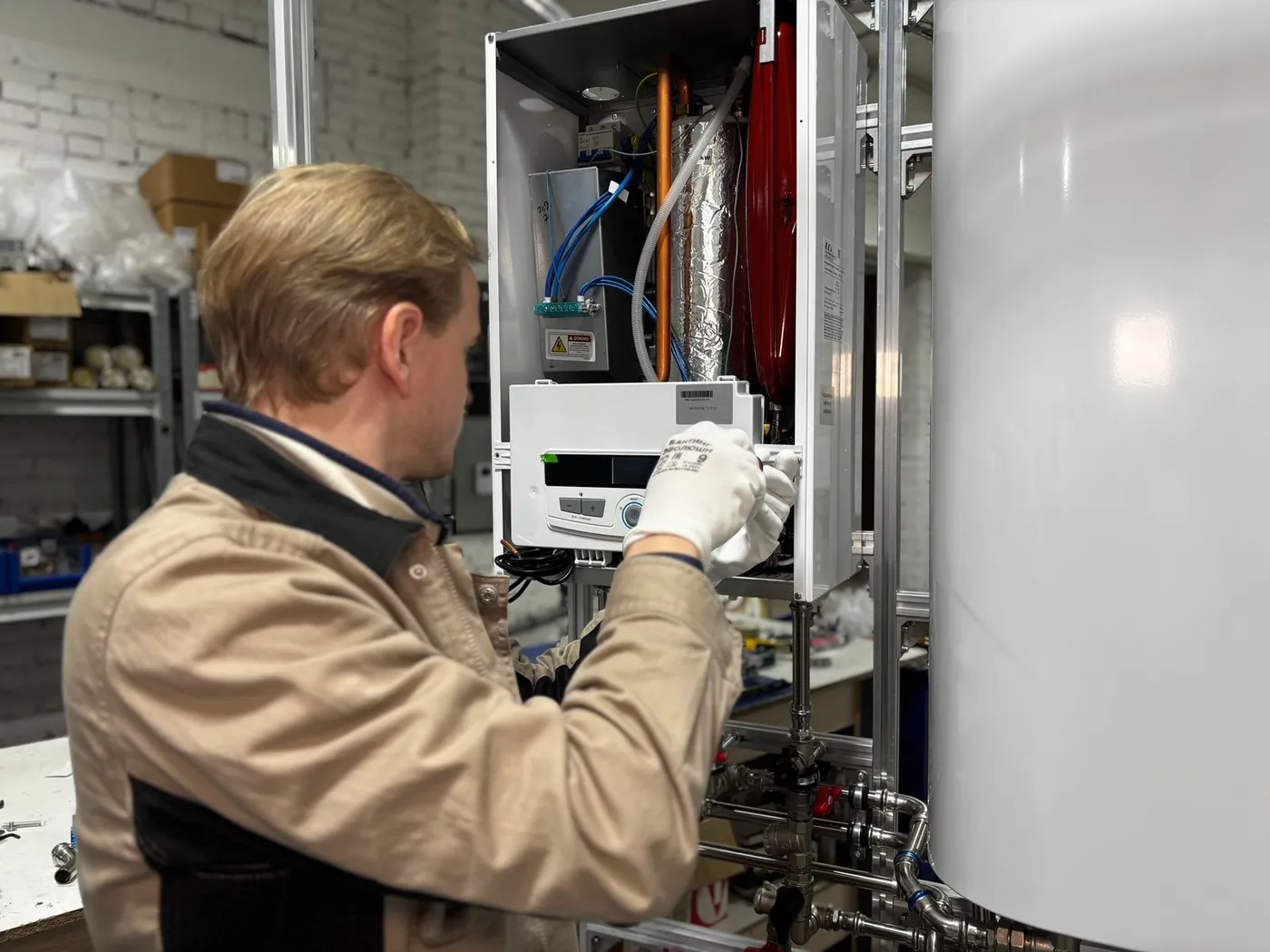
Tankless specialists
Tankless units don't fail the way tanks do — they show error codes, refuse to ignite, or slowly scale shut in hard water. We read the code, descale and service the unit, and only talk replacement when the heat exchanger is genuinely done.
Short answer: look at the display before you touch anything. A tankless unit tells you what it thinks is wrong — ignition failure, flame loss, overheating, exhaust blockage or a maintenance reminder. Write the code down. Half of all tankless callouts in Pflugerville trace back to scale from our 168 mg/L water, and those are service jobs, not replacement jobs.
One thing not to do: keep resetting the unit and forcing it to run. A tankless that is shutting down is protecting itself — overriding it turns a descale into a heat-exchanger replacement.
The Pflugerville problem
A tankless heat exchanger is a coil of narrow passages. Pflugerville's hard water lays scale on those passages every time the unit fires, narrowing them until flow drops, temperatures swing, and the unit starts throwing overheat and flame codes.
Descaling uses the unit's isolation valves and a small pump to circulate a descaling solution through the exchanger until the scale dissolves. In 168 mg/L water it should happen every year — it's the single most valuable service a tankless owner can buy.
If your unit has never been descaled and has started coding, that's still where we start. Scale is reversible; a cracked exchanger isn't.
Reading the unit
Every brand has its own code list, but the fault families are the same: ignition and flame faults (gas supply, igniter, flame sensor), flow faults (clogged inlet filter, scale restriction), temperature faults (overheat protection doing its job), and venting faults (blocked intake or exhaust).
We read the code, check the unit's fault history where it stores one, and test in that order — gas and venting checks before parts, parts before any replacement talk.
Tell us the code when you call and we can usually tell you the likely fix and its price range before we arrive.
If you smell gas near a gas tankless unit, don't touch the unit or any switches — leave the house, then call your gas utility's emergency line, and call us after the utility has cleared the scene. Never run a gas unit with its venting disconnected or its cover removed: the exhaust contains carbon monoxide. Ignition faults on a gas unit are a professional job, not a DIY one.
Tankless faults we fix
Most tankless work here is one of these four.
Worn igniters, dirty flame sensors, gas supply and venting issues — diagnosed from the code outward.
Overheat codes and falling flow from a scaled exchanger. Descale first, judge the unit after.
That cold slug mid-shower. Settings, buffer and recirculation options explained honestly — including when it's not worth fixing.
Water that won't hold temperature usually means flow or scale problems, sometimes a failing sensor — all testable at the unit.
Tankless owners: the maintenance guide covers descaling intervals for Pflugerville water, and the replacement page covers what a tank-to-tankless conversion involves if your old tank is done.
Questions, answered
Tankless costs, ignition faults, the cold-water sandwich and realistic lifespans — answered straight.
Tankless repairs nationally run $150–$1,300, with most homeowners paying $200–$900 and an average around $600 (Angi 2026 data, checked November 2026). Descaling and sensor or igniter work sits at the low end; a heat exchanger repair at $500–$1,300 is the expensive end, and on an older unit it often tips the decision toward replacement. We diagnose from the error code first and quote before work begins.
Ignition failure means the unit tried to fire and couldn't. The common causes are an interrupted gas supply, a worn igniter, a dirty flame sensor, blocked venting or air intake, and — very common in Pflugerville — scale buildup that trips the unit's overheat protection before it will fire. The error code on the display narrows it down; don't keep power-cycling the unit, note the code and call us.
It's the burst of cold water you feel mid-shower when a tankless unit restarts: you get hot water, then a slug of cold, then hot again. It happens because the unit shuts off when flow pauses and takes a few seconds to refire. Fixes range from adjusting minimum flow settings to adding a small buffer or recirculation setup — we look at your unit and usage pattern before recommending one.
Yes — with maintenance. Tankless units commonly last 20 years or more, against roughly 10 to 15 years for a tank (Angi). The catch is in the words 'with maintenance': in Pflugerville's 168 mg/L water, a tankless heat exchanger that is never descaled can scale up and fail years early. Annual descaling is what turns the longer design life into an actual longer life.
Pflugerville Water Heater Pros
Tell us the error code when you call — we'll tell you the likely cause and the price range before we come out.
Illustrative photo